

Take Charge and Move Out
More doomsday radio systems

It’s not really my place or intention to use this platform to impart advice. My parents had two rules for my brother and I growing up:
Be financially self-sufficient ✅
Be heterosexual ✅
My parents are products of their time but I cosign rule #1 and take a traditional libertarian view of rule #2 - which is to stay I don’t care or think about what two consenting adults do behind closed doors.
If I had to develop my own version of this it would go something like: humans require directed suffering, hard work, and a commitment to a shared enterprise, and a small part of accomplishing that is you taking responsibility for your own life. If something bad happens to you - whether that be a breakup, or a change in employment status. Nobody is coming to save you, nobody is going to take time out of their already busy days and help you get back on your feet like you would. At some point you have to grab the wheel yourself and take charge of your own situ.
So with my little preamble out the way, in hindsight, it was probably inevitable that I’d end up writing about a platform with the wonderfully on-the-nose name that sort embodies this: Take Charge and Move Out.

I’ve done a few installments on Very Low Frequency (VLF) and Extremely Low Frequency (ELF) transmitters. These systems sit at the heart of strategic nuclear communications, providing links to submerged submarines, hardened command centers, and other assets that must remain reachable under the worst imaginable conditions. They are engineering marvels: massive fixed installations with dedicated power infrastructure, sprawling antenna fields, and budgets that only nation-states can justify.
They also share one fatal flaw. They are sitting ducks!
No matter how hardened, dispersed, or defended a transmitter site may be, its location is ultimately known. It’s easy to triangulate and they are so big that they quite easy to observe from satellite imagery. In a major conflict, fixed communications nodes become natural targets - typically they are some the first targets struck. A transmitter that cannot move must survive whatever the enemy throws at it - or be replaced by something that can.
So how do you take one of the least mobile forms of radio communication ever invented and make it mobile?
The challenge is not simply putting a transmitter on an aircraft, ship, or drone. Very Low Frequency communications operate between approximately 3 and 30 kHz, where radio wavelengths become enormous. At these frequencies, the antenna is often a bigger problem than the transmitter itself.
I Apologize for the Math
Really quickly - the wavelength of a radio signal is determined by:
λ = c / f
Where:
λ = wavelength
c = speed of light (~300,000,000 m/s)
f = frequency
At 20 kHz, the wavelength is approximately 15 kilometers (9.3 miles). At 15 kHz, the wavelength grows to roughly 20 kilometers (12.4 miles).
Traditional antenna theory would suggest that an efficient radiator should be a significant fraction of a wavelength, often one-quarter wavelength or longer. At 20 kHz, a quarter-wave antenna would be approximately 3.75 kilometers tall.
That is why fixed VLF stations look the way they do. They are attempts to build antennas that are at least somewhat compatible with wavelengths measured in tens of kilometers. I have gone over this before in other posts and numerous times in notes.
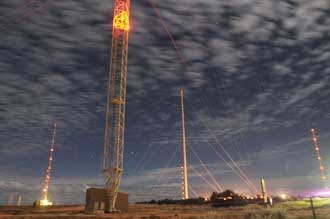
But what happens when you need VLF communications and cannot rely on a fixed site? What happens when the transmitter itself has to move?
Mobile VLF
During the cold war both the United States and Soviet Union expected that any major conflict would almost certainly include attacks on communications infrastructure. Even the largest and most heavily protected VLF stations sat in known locations that an enemy could target. The Department of War (Defense) is all about redundancy - if a transmitter on the ground was vulnerable, why not put one in the air? That quickly runs into a numbers problem.
A large military aircraft might be somewhere between 40 or 60 meters long. The signal it needed to transmit could have a wavelength of 15 or even 20 kilometers. It’s like trying to play a church organ with a toothpick. Then engineers came up with an answer that was equal parts elegant and unconventional. Instead of carrying the antenna, the aircraft would drag it behind itself.
Take Charge and Move Out
The most famous mobile VLF platform is the U.S. Navy’s TACAMO aircraft.
TACAMO stands for: Take Charge And Move Out
The mission grew out of one of the Cold War’s concerns about how to maintain contact with strategic forces if normal communications networks were damaged or destroyed. The phrase itself emerged during the Cold War when the U.S. Navy was developing an airborne survivable communications capability for the strategic nuclear force. An aircraft was to "take charge" of strategic communications and "move out" of vulnerable locations.
Today that responsibility belongs to the Boeing E-6B Mercury.
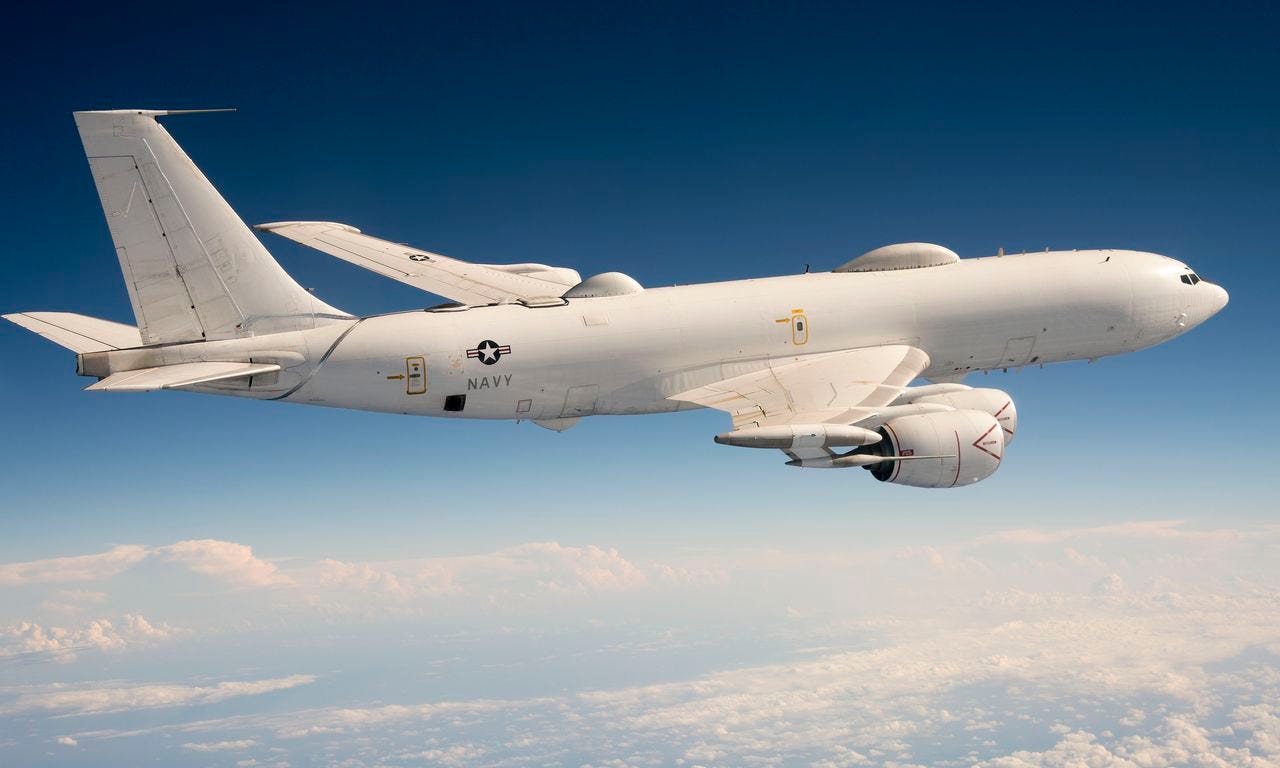
From a distance, the aircraft looks much like a modified commercial airliner. There is little about its appearance that hints at its unusual role. Its most important feature is usually invisible.
The Trailing Wire Antenna
If an aircraft could not carry a giant antenna, perhaps it could tow one. The E-6 deploys a trailing wire antenna from the rear of the aircraft. The trailing wire antenna is approximately 5 miles (8 kilometers) long. Once airborne, the crew reels the wire out behind the aircraft until it stretches for miles through the sky. That wire becomes the primary radiating element for VLF transmissions.
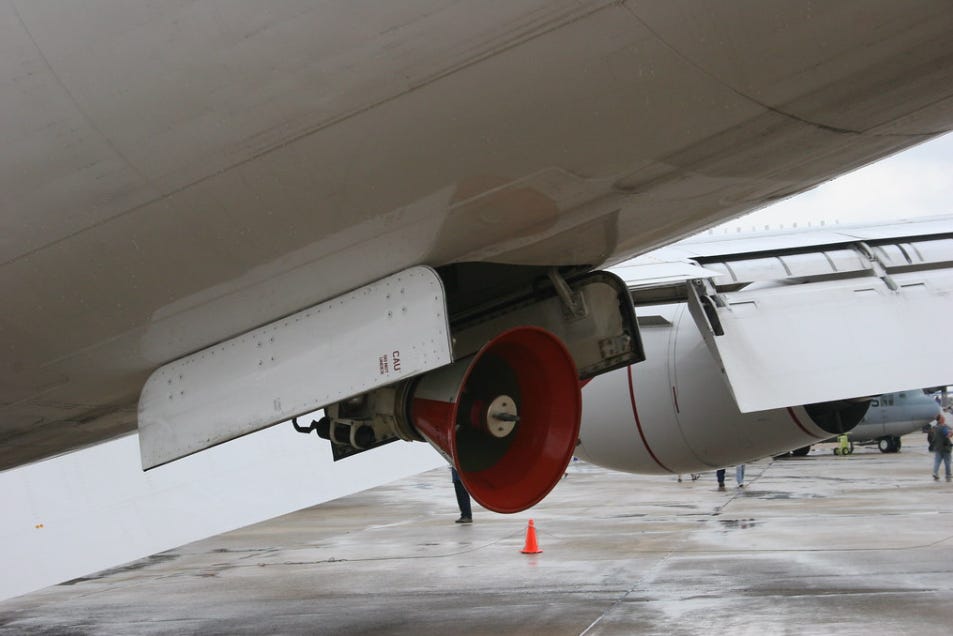
At the end of the wire is a drogue, a small aerodynamic device that acts much like an parachute. The drogue creates drag that helps keep the antenna wire taut and stable during flight. Without it, the wire could sag excessively or become more difficult to control, reducing the effectiveness of the antenna system. When one imagines the E-6, they often imagine a flying command post carrying sophisticated radios. In reality, it is also carrying part of an antenna that unfolds across a significant portion of the horizon.
Flying Techniques
Imagine an aircraft towing a 5-mile long wire antenna at normal cruising speed. The wire would stream backward almost horizontally, much like a fishing line trailing behind a fast-moving boat. That is not the shape you want for good propagation. For VLF transmission, a strong vertical component helps the signal couple into the Earth-ionosphere waveguide1, the natural channel that allows these frequencies to travel enormous distances. So you want to keep the wire hanging downward as much as possible. To do that, the E-6 does something unusual. During transmission operations, it slows down and enters a large circular orbit. The reduced airspeed lowers the drag on the wire, allowing gravity to pull more of it toward a vertical position.
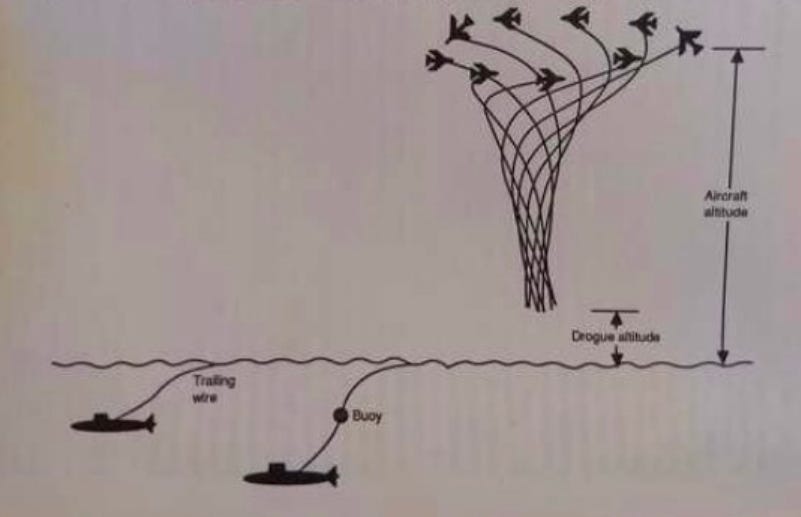
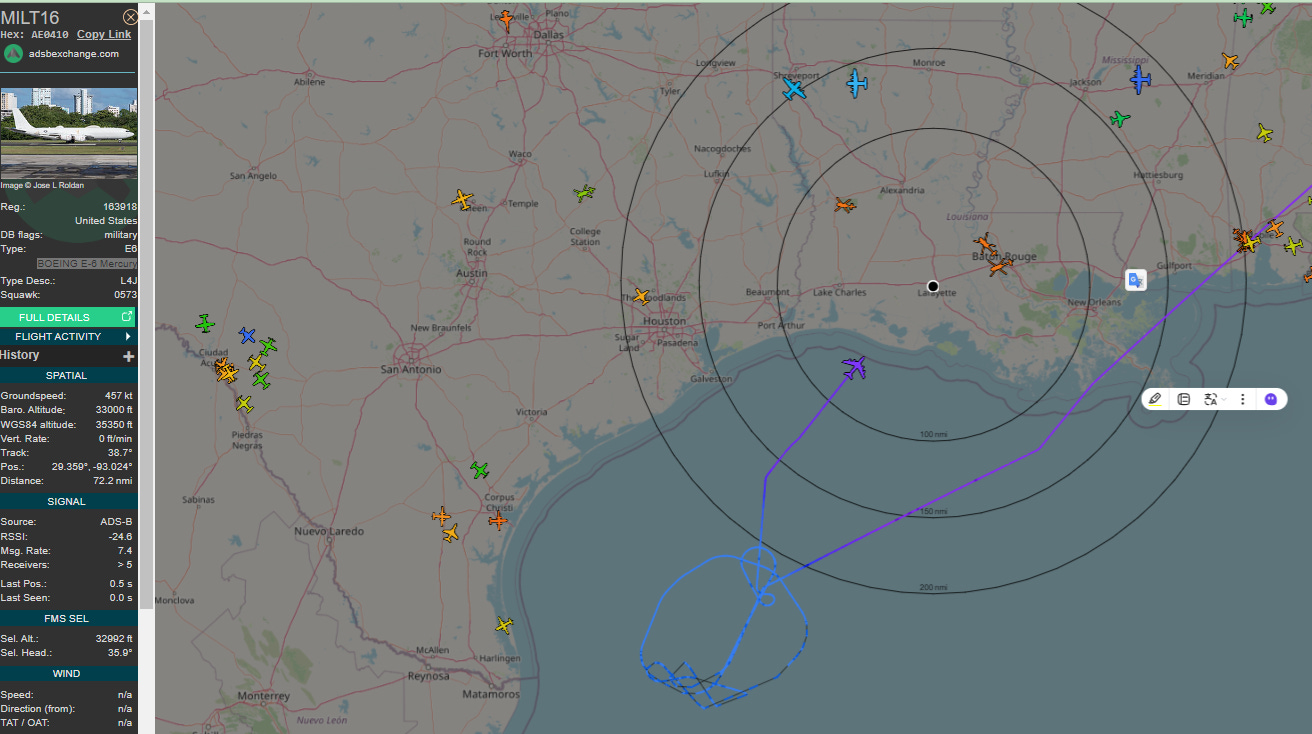
The aircraft may fly only modestly above stall speed while maintaining a carefully controlled bank angle. The flight crew is actively shaping the antenna suspended behind them. Gravity, drag, airspeed, and bank angle all influence how well the system performs. Few military missions blur the line between aviation and radio engineering quite so completely.
Other Airborne Strategic Communications Aircraft
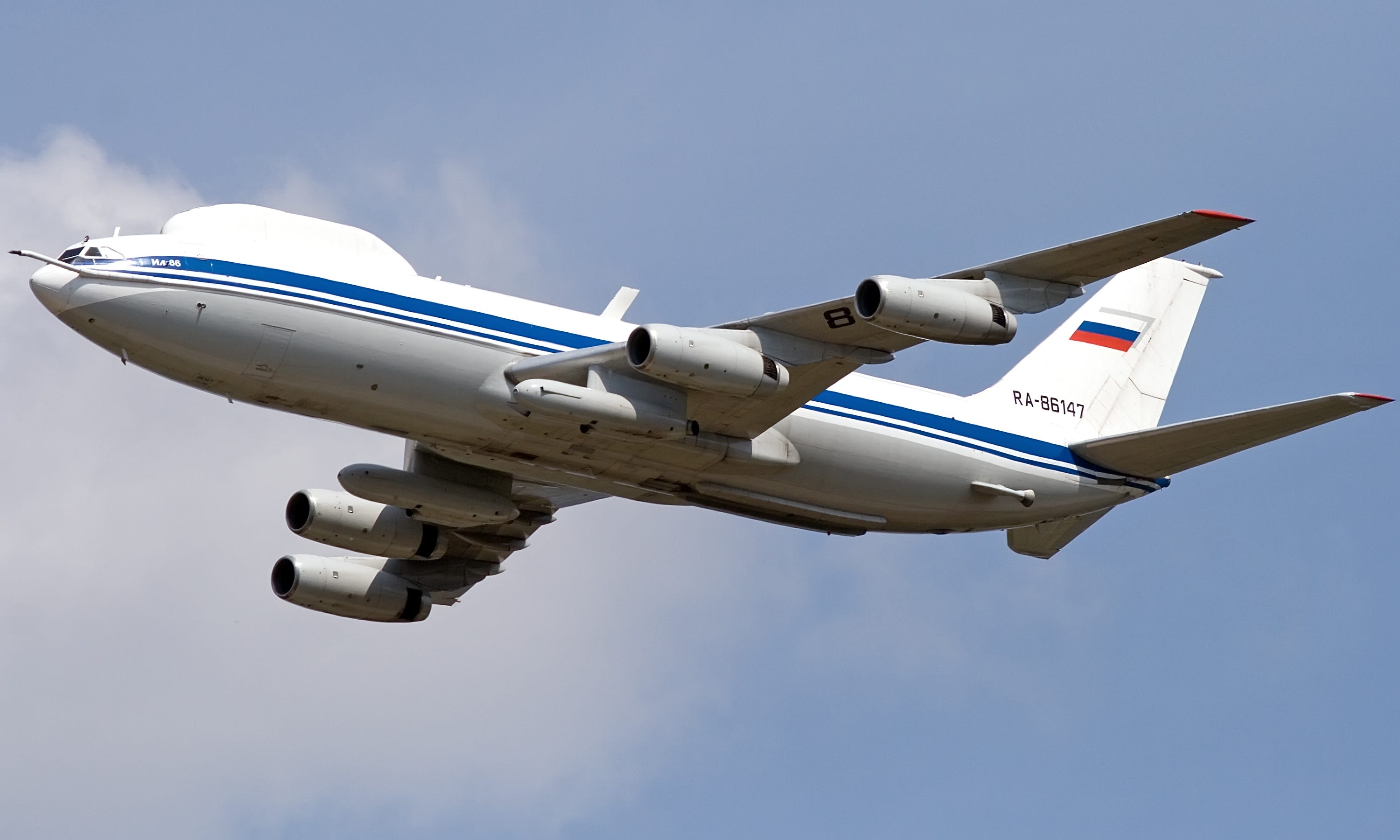
The Soviet Union faced the same strategic problem and arrived at similar solutions. Aircraft associated with airborne command-and-control missions include:
Ilyushin Il-80 “Maxdome”
Ilyushin Il-82
These aircraft are believed to form part of Russia’s airborne nuclear command infrastructure. Open-source imagery has shown long-wire antenna arrangements associated with these platforms, suggesting strategic communications capabilities similar to TACAMO. Because the systems remain highly classified, exact details are difficult to verify.
Anything else?
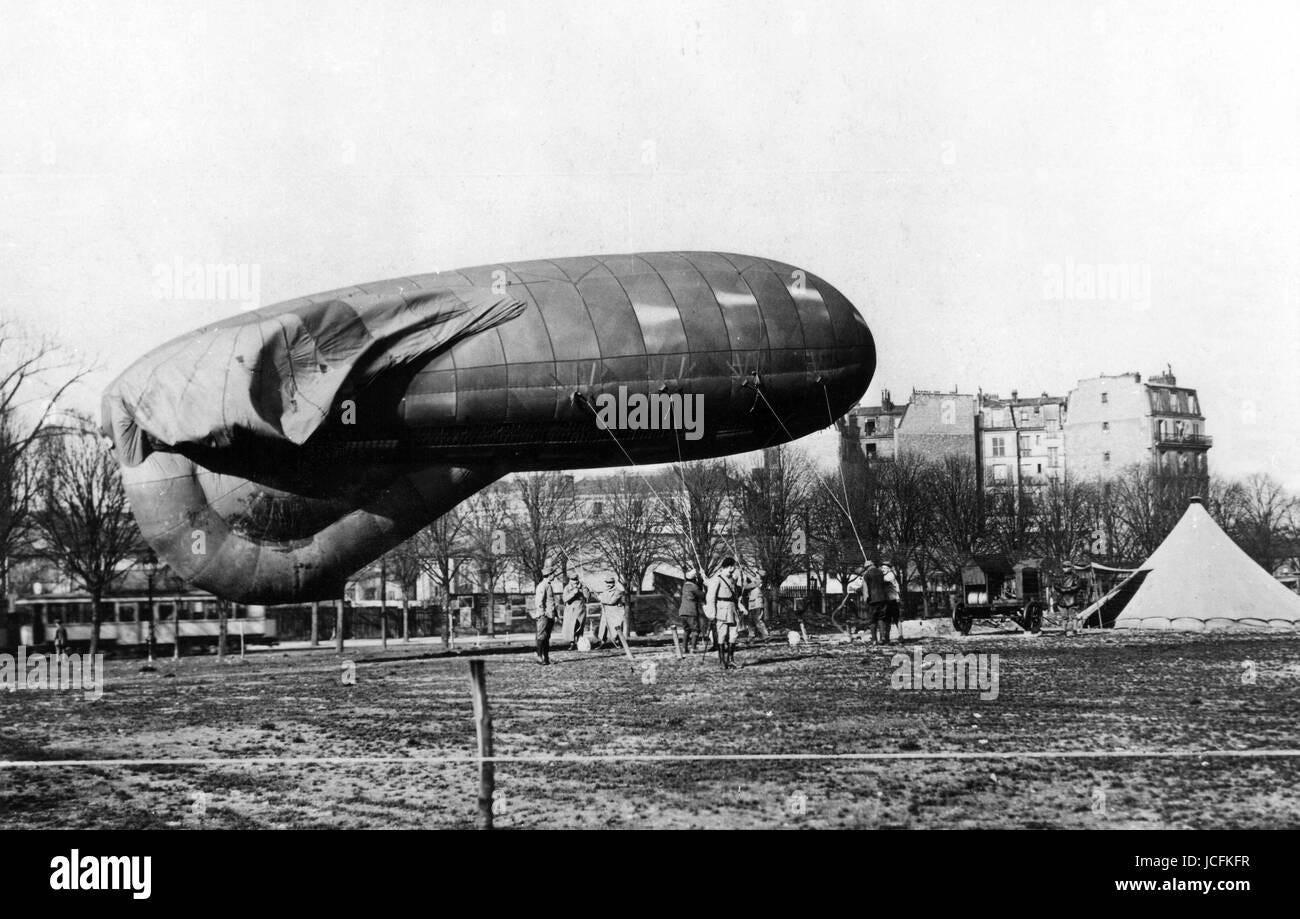
Drones are always postulated as the next big thing but VLF transmission requires substantial electrical power. Many UAVs simply do not generate enough onboard power to support high-power VLF operations. In this area you may actually see modern militaries move ‘back in time.’ There were the observation balloons in WWI.
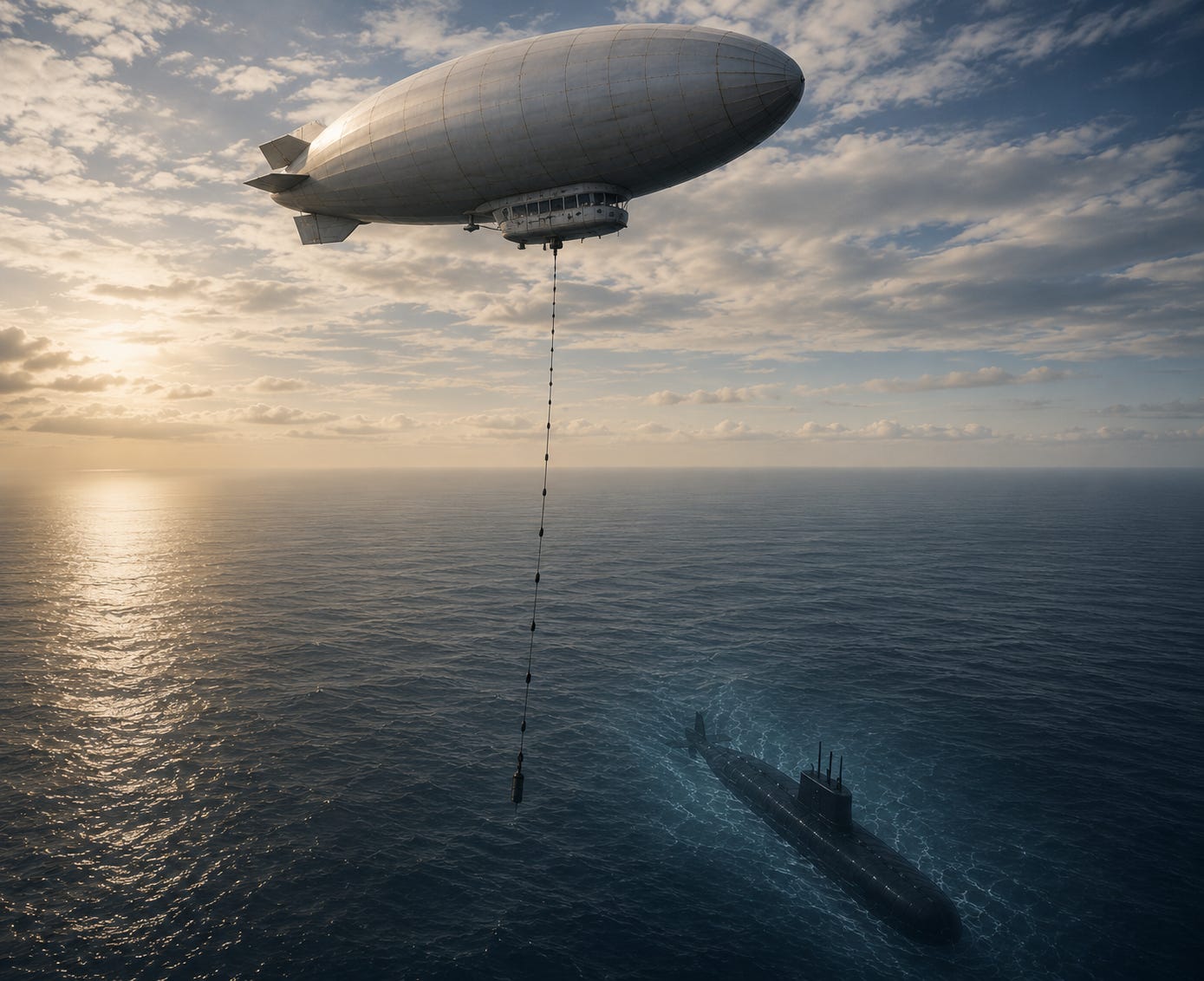
A theoretical high-altitude airships and near-space balloon offer the possibility of maintaining a long vertical antenna for days or weeks at a time, potentially providing a more efficient VLF radiator than a continuously orbiting aircraft. Whether such systems remain theoretical or have progressed into classified operational programs remains unknown, but the underlying physics make them an attractive avenue for research.
This is my first article written per request. I believe the mobile strategic command post was requested by Handle, a frequent commenter in my little cul-de-sac of Substack. As always - I am open to article requests and to answer questions. If you have a request please comment below or shoot me a DM. Thank you for reading. 💗
If you enjoyed this article you may also like:
Chicken Soup for the Radiostack Reader’s Soul

It may sound strange - but if you, yes you 🫵 reading this, sat next to me at work for about six months - I could teach you the basics of this job. The concepts are relatively simple and they repeat. Most of the antenna technology hasn’t really changed much in the last 70 years.
The region between Earth’s surface and the ionosphere (roughly 60-90 km altitude) that acts as a natural waveguide for extremely low frequency and very low frequency electromagnetic waves. These waves can propagate long distances around the globe by reflecting between the conductive Earth’s surface and the ionized layers of the ionosphere.
I stopped reading after the preamble, but I'm sure you know your radio stuff.
Fascinating and educational. In the US, amateur radio licensees are allowed 1 W EIRP maximum 135.7-137.8 kHz: CW, Phone, Image, RTTY/Data. I know it’s been tried before but would be fun to use a tethered helium balloon to dangle a VLF antenna. I’ve never done any ham transmitting below the 160 meter band so this would be new territory for me.